Sani Abacha Biography: Age, Career & Net Worth
Read the full biography of Sani Abacha — Nigeria’s military head of state from 1993 to 1998. Explore his early life, military career, controversies, family, and lasting legacy.
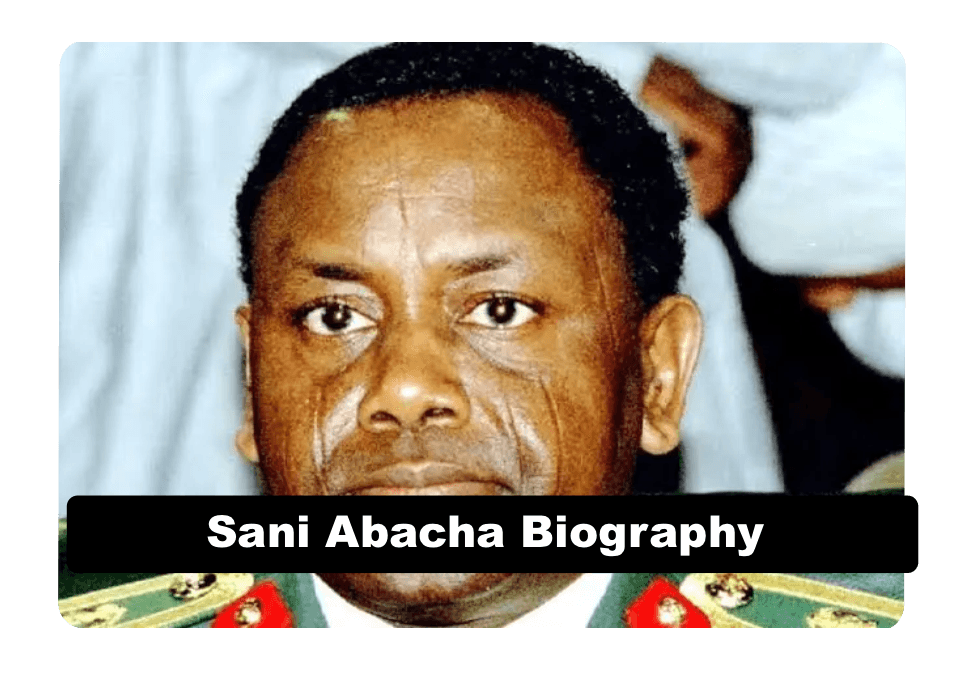
Sani Abacha remains one of the most controversial figures in Nigerian history. Born in Kano in 1943, he rose steadily through the ranks of the Nigerian military over three decades before seizing power in November 1993. His five-year rule as military head of state was defined by authoritarian governance, sweeping human rights abuses, and alleged embezzlement of billions of dollars from Nigeria’s treasury.
Yet his legacy is not entirely one-dimensional. Abacha’s administration oversaw significant gains in Nigeria’s foreign exchange reserves, reduced external debt, and funded infrastructure development through the Petroleum Special Trust Fund. He remains a deeply polarising figure — feared and condemned by many, and quietly defended by others — whose impact on Nigeria’s political and economic history endures to this day.
Quick Facts About Sani Abacha
| Detail | Information |
|---|---|
| Full Name | Sani Abacha GCFR |
| Date of Birth | September 20, 1943 |
| Place of Birth | Kano, Kano State, Nigeria |
| Date of Death | June 8, 1998, Abuja, Nigeria |
| Age at Death | 54 years old |
| Ethnicity | Kanuri (from Borno State) |
| Religion | Islam |
| Spouse | Maryam Abacha (married 1965) |
| Children | 7 sons, 3 daughters |
| Profession | Military Officer, Head of State |
| Years in Power | November 17, 1993 – June 8, 1998 |
| Estimated Embezzled Funds | $2–5 billion USD |
Early Life and Family Background
Sani Abacha was born on September 20, 1943, in Kano, northern Nigeria, into a Kanuri family with roots in Borno State. His father, Alhaji Abacha Maiduguri, was a prominent figure who served as president of the Northern Traders Amalgamated Union, giving the family a respected standing in the community. Growing up in Kano, young Sani was known to be quiet and reserved, showing little early indication of the commanding and feared leader he would become.
He attended the City Senior Primary School in Kano before proceeding to the Provincial Secondary School — later renamed Government College Kano — where he studied from 1957 to 1962. By all accounts, Abacha was an unremarkable student academically, but he possessed a sharp, calculating instinct that would serve him well in the military world he was about to enter.
Education and Military Training
Just four days after completing his school certificate examination in 1962, Abacha enlisted in the Nigerian Army and entered the Nigerian Military Training College in Kaduna. He subsequently trained at the MONS Defence Officers Cadet Training College in Aldershot, United Kingdom, in 1963, and was commissioned as a second lieutenant that same year.
His military education continued throughout his career. He attended the School of Infantry in Warminster, United Kingdom (1966 and 1971), the Command and Staff College in Jaji, Nigeria (1976), the National Institute for Policy and Strategic Studies in Kuru, Jos (1981), and the Senior International Defence Course in Monterey, California, United States (1982). This extensive training across three continents shaped him into one of Nigeria’s most technically prepared military officers.
Military Career and Rise to Power
Abacha’s military career spanned three decades and touched nearly every major political turning point in Nigeria’s post-independence history. He rose from second lieutenant in 1963 through the ranks without ever skipping a grade — a rare distinction that made him the first Nigerian officer to become a full four-star general through a strictly sequential progression.
He gained national prominence on December 31, 1983, when he announced the coup that ended the civilian government of President Shehu Shagari, ushering in the military regime of General Muhammadu Buhari. Two years later, he participated in the coup that removed Buhari and installed General Ibrahim Babangida, under whom Abacha served as Chief of Army Staff and later as Minister of Defence from 1990.
His third and most consequential seizure of power came on November 17, 1993. Following Babangida’s annulment of the June 12 presidential election — widely believed to have been won by Moshood Abiola — and the collapse of the interim government under Chief Ernest Shonekan, Abacha stepped in and took control of Nigeria without firing a single shot. It was a bloodless but consequential coup, and it marked the beginning of one of Nigeria’s darkest political chapters.
Rule as Head of State (1993–1998)
Once in power, Abacha quickly abandoned his initial promises of a democratic transition. He dissolved all democratic institutions, banned political activity, and assembled a personal security force of around 3,000 men. His government declared itself above the jurisdiction of Nigerian courts in September 1994, effectively placing the regime beyond any legal accountability.
His most internationally condemned act was the execution of environmental activist and writer Ken Saro-Wiwa and eight other Ogoni activists on November 10, 1995. The executions prompted Nigeria’s suspension from the Commonwealth of Nations and drew widespread global outrage. Other prominent figures — including former head of state Olusegun Obasanjo and Nobel laureate Wole Soyinka — were either jailed for treason or forced into exile during this period.
Despite these abuses, Abacha’s administration recorded some economic achievements. Nigeria’s foreign exchange reserves grew from $494 million in 1993 to $9.6 billion by mid-1997. External debt fell from $36 billion to $27 billion over the same period. Inflation dropped from 54% to 8.5%. The Petroleum Special Trust Fund (PTF) he established delivered infrastructure improvements across roads, health, education, and water supply in multiple states.
Personal Life and Family
Abacha married Maryam Jidah in 1965, when he was 22 and she was just 17. She was also of Shuwa Arab descent from Borno State. Together they had seven sons and three daughters. Their eldest son, Ibrahim Abacha, died tragically in a plane crash in 1996. Their youngest child was born at Aso Rock in 1994.
Maryam Abacha, despite the controversies surrounding her husband’s regime, made a lasting contribution to Nigerian healthcare by founding what is now the National Hospital Abuja, originally established as the National Hospital for Women and Children. After her husband’s death, she was intercepted at the airport attempting to leave Nigeria with 38 suitcases reportedly filled with cash.
Net Worth and Alleged Embezzlement
Sani Abacha is widely regarded as one of the most corrupt leaders of the 20th century. Estimates of the funds he and his associates looted from Nigeria range between $2 billion and $5 billion USD, with some sources placing the figure as high as $6 billion. The money was funnelled through fake national security funding requests approved by Abacha himself, then laundered into offshore accounts in Switzerland, Liechtenstein, and other financial centres.
Recovery efforts have continued for decades after his death. By 2002, the Obasanjo government reached a settlement with the Abacha family, returning a portion of stolen funds in exchange for dropping criminal prosecution. Billions in assets were traced to Middle Eastern and Western banks, with repatriation efforts ongoing well into the 2010s.
Death and Controversy
Sani Abacha died on June 8, 1998, at the Presidential Villa in Abuja under circumstances that remain disputed. The official cause of death was listed as a sudden heart attack. He was buried in Kano the same day, in keeping with Islamic tradition, and without an autopsy — a decision that fuelled decades of speculation about foul play.
News of his death was received with relief and jubilation across much of Nigeria. His military successor, General Abdulsalami Abubakar, swiftly announced a transition to civilian rule, which culminated in the election of President Olusegun Obasanjo in 1999 and the birth of Nigeria’s Fourth Republic.
In December 2025, Abacha was posthumously awarded an honorary doctorate by Maryam Abacha American University of Nigeria (MAAUN) in Kano, received on his behalf by his eldest surviving son, Mohammed Abacha.
Legacy
Sani Abacha’s legacy is deeply contested. To his critics — the majority — he represents the worst of military despotism: a kleptocrat who enriched himself and his family while suppressing democracy, executing dissidents, and isolating Nigeria from the global community. To a smaller group, he is remembered for economic stabilisation, infrastructure delivery, and regional peacekeeping efforts in Liberia and Sierra Leone.
What is beyond dispute is that his five years in power left a profound and lasting mark on Nigeria’s political culture, economy, and international standing. The recovery of “Abacha loot” remains an ongoing legal and diplomatic process more than two decades after his death — a testament to both the scale of his corruption and the difficulty of undoing it.
Final Thoughts
Sani Abacha’s story is one of extraordinary military ascent shadowed by ruthless authoritarian rule. He climbed from a quiet boy in Kano to the pinnacle of Nigerian state power, and in doing so, left behind a legacy defined as much by what he took as by what he built.
Nigeria has continued to reckon with his memory — pursuing stolen funds abroad, debating his economic record, and navigating a political landscape he helped shape. Whether viewed as a statesman or a dictator, Abacha remains impossible to ignore in any honest account of modern Nigerian history.
Frequently Asked Questions
Q1: Who was Sani Abacha?
Sani Abacha was a Nigerian military officer who served as the country’s head of state from November 1993 until his death in June 1998. He came to power through a bloodless coup and ruled with an authoritarian hand. He is remembered as one of Africa’s most corrupt 20th-century leaders.
Q2: When was Sani Abacha born and when did he die?
Sani Abacha was born on September 20, 1943, in Kano, Nigeria. He died on June 8, 1998, in Abuja, at the age of 54. The official cause of death was a heart attack, though the circumstances remain disputed.
Q3: How much money did Sani Abacha steal?
Estimates vary, but Abacha and his associates are alleged to have embezzled between $2 billion and $5 billion from Nigeria’s treasury. Some sources put the figure as high as $6 billion. Recovery efforts by successive Nigerian governments have continued for decades.
Q4: Who was Sani Abacha’s wife?
Sani Abacha was married to Maryam Abacha (née Jidah) in 1965. She is of Shuwa Arab descent from Borno State. Together they had seven sons and three daughters. Maryam founded the National Hospital Abuja and remains alive.
Q5: What were Sani Abacha’s major achievements?
Despite his brutal reputation, Abacha grew Nigeria’s foreign exchange reserves from $494 million to $9.6 billion, reduced external debt, cut inflation from 54% to 8.5%, and established the Petroleum Special Trust Fund which delivered roads, healthcare, and water projects across Nigeria.
Q6: Why was Sani Abacha internationally condemned?
Abacha drew global condemnation primarily for the execution of environmental activist Ken Saro-Wiwa and eight other Ogoni activists in November 1995. Nigeria was suspended from the Commonwealth of Nations as a result. He also jailed political opponents, including Moshood Abiola and Olusegun Obasanjo.
Q7: What happened to Nigeria after Sani Abacha’s death?
After Abacha’s death, General Abdulsalami Abubakar became head of state and quickly initiated a transition to civilian rule. Olusegun Obasanjo was elected president in 1999, marking the start of Nigeria’s Fourth Republic. Efforts to recover funds looted by Abacha began almost immediately.